
Best AI Tools for On-Page SEO in 2026: Improve Rankings and Content Quality
Introduction
Creating great content is only half the battle. Even the most informative article can struggle to rank if it is not properly optimized for search engines.
A few years ago, on-page SEO required hours of manual work. Marketers had to analyze competitor pages, check keyword placement, optimize headings, write meta descriptions, and ensure proper content structure. The process was time-consuming and often inconsistent.
Today, AI-powered SEO tools have transformed the way content optimization works.
Modern tools can analyze top-ranking pages, identify missing topics, suggest improvements, and help writers create content that satisfies both search engines and readers.
In this guide, we’ll explore the best AI tools for on-page SEO, how they work, and how you can use them to improve rankings and drive more organic traffic.
What Is On-Page SEO?
On-page SEO refers to all optimization activities performed directly on a webpage.
These elements include:
- Title tags
- Meta descriptions
- Headings (H1, H2, H3)
- Content quality
- Internal linking
- Image alt text
- URL structure
- Keyword optimization
The purpose of on-page SEO is to make content easier for search engines to understand while providing a better experience for users.
Unlike off-page SEO, which focuses on backlinks, on-page SEO gives you complete control over optimization.
Why AI Tools Are Changing On-Page SEO
Artificial intelligence has made SEO faster, smarter, and more efficient.
Instead of manually analyzing dozens of competing pages, AI tools can process large amounts of data within seconds.
These tools help users:
- Identify content gaps
- Improve keyword usage
- Optimize readability
- Analyze competitors
- Generate content briefs
- Improve search visibility
As search engines become more sophisticated, using AI tools can provide a significant competitive advantage.
Best AI Tools for On-Page SEO

1. Surfer SEO
Surfer SEO is one of the most popular content optimization tools available today.
It analyzes top-ranking pages for a target keyword and provides recommendations to improve your content.
Key Features
- Real-time content scoring
- Keyword suggestions
- Competitor analysis
- Content structure recommendations
- NLP keyword optimization
Advantages
- Easy-to-follow recommendations
- Excellent content editor
- Helpful for improving rankings
Limitations
- Can encourage over-optimization if followed blindly
- Premium pricing may not suit beginners
Best For
Bloggers, affiliate marketers, and content creators who want detailed optimization guidance.
2. Clearscope
Clearscope focuses on content quality and topical relevance.
Many content teams use Clearscope to create comprehensive articles that fully satisfy search intent.
Key Features
- Content grading
- Semantic keyword recommendations
- Readability analysis
- Competitor content insights
Advantages
- User-friendly interface
- Strong topic recommendations
- Excellent content quality guidance
Limitations
- Higher monthly cost
- Better suited for larger content teams
Best For
Businesses and agencies creating high-value content.
3. Frase
Frase combines content research and optimization in one platform.
It helps users understand what information competitors are covering and what questions readers are asking.
Key Features
- AI content briefs
- Competitor analysis
- Question research
- Content optimization
Advantages
- Great for content planning
- Saves research time
- Helps build comprehensive articles
Limitations
- Learning curve for beginners
- Some recommendations require manual review
Best For
Content marketers and SEO professionals.
4. Rank Math
Rank Math is one of the most popular WordPress SEO plugins.
It provides practical optimization recommendations directly within the WordPress editor.
Key Features
- SEO scoring
- Internal link suggestions
- Meta tag optimization
- Schema markup support
- Content analysis
Advantages
- Beginner friendly
- Affordable
- Easy integration with WordPress
Limitations
- Not as advanced as dedicated AI content platforms
Best For
WordPress users and bloggers.
5. Yoast SEO
Yoast SEO remains a trusted SEO plugin used by millions of websites worldwide.
It helps improve readability and basic on-page optimization.
Key Features
- SEO analysis
- Readability scoring
- Meta description checks
- Keyword optimization
Advantages
- Easy to use
- Trusted by website owners
- Good for beginners
Limitations
- Limited advanced AI features
Best For
Small websites and beginners.
How to Use AI Tools for On-Page SEO
Following a structured workflow can improve results significantly.
Step 1: Research the Topic
Use Frase or similar tools to understand search intent and identify important subtopics.
Step 2: Create High-Quality Content
Focus on providing helpful, accurate, and comprehensive information.
Step 3: Optimize Content
Use Surfer SEO or Clearscope to identify missing topics and keyword opportunities.
Step 4: Improve Technical Elements
Optimize title tags, meta descriptions, internal links, and image alt text.
Step 5: Publish and Monitor
Track performance using Google Search Console and make updates when necessary.
Best Practices for On-Page SEO
To maximize performance:
- Write for users first
- Use clear headings
- Add internal links
- Include relevant images
- Improve readability
- Optimize page titles
- Keep content updated
These practices help improve rankings and user experience simultaneously.
Common Mistakes to Avoid
Many website owners make avoidable SEO mistakes.
Avoid:
- Keyword stuffing
- Thin content
- Ignoring search intent
- Poor internal linking
- Over-optimizing for SEO scores
Remember, content should always feel natural and useful.
Future of AI in On-Page SEO
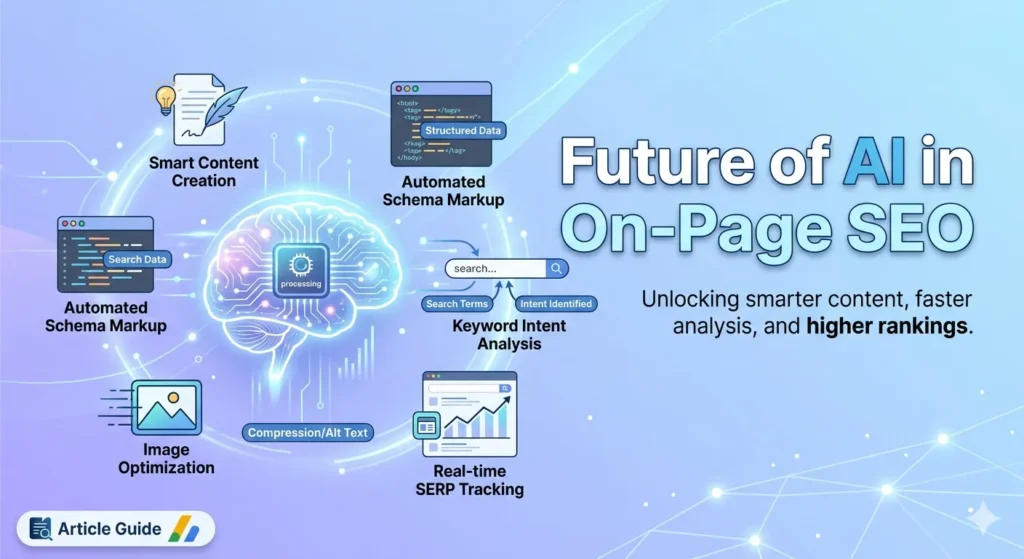
AI will continue to play a larger role in content optimization.
Future developments may include:
- Advanced search intent analysis
- Automated content recommendations
- Predictive SEO insights
- Better content personalization
Businesses that adapt early will have a stronger competitive advantage.
Frequently Asked Questions
What is the best AI tool for on-page SEO?
Surfer SEO is considered one of the best tools due to its comprehensive content optimization features.
Is Rank Math enough for SEO?
Rank Math covers most essential on-page SEO tasks, especially for WordPress users.
Can AI tools improve rankings?
AI tools help optimize content and improve SEO performance, but rankings also depend on content quality, competition, and backlinks.
Do beginners need paid SEO tools?
Not necessarily. Beginners can start with Rank Math, Yoast SEO, and Google Search Console.
How often should content be optimized?
Review and update important pages every 6 to 12 months to maintain rankings.
Conclusion
On-page SEO remains one of the most important aspects of search engine optimization.
AI-powered tools make the process faster, smarter, and more effective by helping users identify content gaps, improve readability, and optimize content structure.
Whether you choose Surfer SEO, Frase, Clearscope, Rank Math, or Yoast SEO, the key is to use these tools as assistants rather than replacements for human expertise.
Focus on creating valuable content, optimizing it intelligently, and providing the best possible experience for your audience.
The combination of quality content and smart optimization is what ultimately drives long-term SEO success.